|

|
|
Issue #112 · August 30, 2026
OpenAI's Licensing Deals Are Paying Off — On ChatGPT Only: A 48% Citation Premium for Licensed Publishers
August 20, 2026 · Press Ranger & OtterlyAI
A joint Press Ranger / OtterlyAI analysis of 129.3 million citations across seven AI platforms (June 2026) finds that pages from publishers with an OpenAI licensing deal collect 10.2 citations per page on ChatGPT versus 6.9 for unlicensed publishers — a 48% premium. Publishers with exclusive OpenAI deals do even better, earning 112% more citations per page than the unlicensed baseline.
The advantage is strictly ChatGPT's own — it doesn't transfer: publishers with Google licensing deals actually saw slightly lower citation rates in AI Overviews, and Perplexity's licensed partners saw no measurable edge at all. You can't buy your way into an OpenAI deal, but you can benefit indirectly by earning coverage in outlets that already have one. Worth flagging: this is vendor-backed research covering a single month, correlational rather than causal.
|
|
|
|
|
|
Standards · Sep 2025–Apr 2026 · Digital Applied
AI Crawlers Fetch llms.txt Almost Never — the Real Traffic Was a Bot Aggregator, Not an AI Lab
Adoption of llms.txt is real — 51.8% among developer-focused hosts, though just 8.7% across the Tranco top 1,000. But a seven-month server-log study of ~900 domains logged only 1,227 llms.txt requests total, and zero came from a frontier AI lab crawler — 64.7% were a commercial data aggregator, the rest human browsers. A separate 300,000-domain study found removing llms.txt had no negative effect on citation odds. Ship it for coding agents and MCP clients, not as an SEO lever.
|
|
Read the data ->
|
|
|
|
|
|
|
|
Data · 2026 · SE Ranking, via Alhena.ai
65% of Pages Cited by Google AI Mode Carry Schema Markup — 71% on ChatGPT
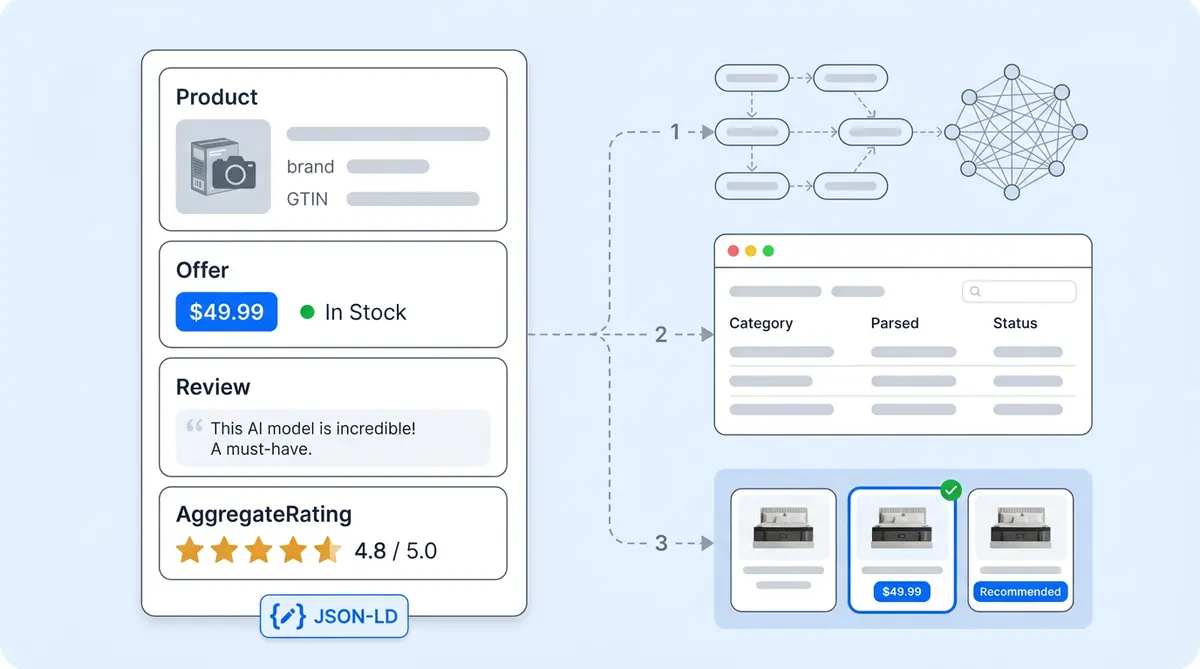
SE Ranking's data finds a consistent structured-data signature across the pages AI systems actually cite: 65% carry schema markup for Google AI Mode citations, 71% for ChatGPT. As the researchers put it, "a product without valid GTIN and Offer schema does not lose rank in AI search — it never enters the comparison at all." The fix is infrastructure, not a hack: JSON-LD at scale, server-side rendered from the real product/content database, with core fields (price, availability, ratings, author, organization) validated and accurate.
|
|
See the research ->
|
|
|
|
Study · August 20-21, 2026 · The Happy Cat
ChatGPT, Perplexity and Gemini Cited 104 Different Sources for the Same 10 Questions — and Agreed on Just 3
An AI-visibility agency ran 10 identical buyer questions through all three assistants and logged 30 answers citing 104 distinct sources — only 11 cited more than once, and only 3 businesses recommended by all three. The pattern behind the split: ChatGPT favors company sites carrying tracking tags, Perplexity favors third-party comparison content, Gemini rewards substantive published articles. There is no single "AI SEO" — each platform is grading on different criteria, which is exactly the opening smaller, quotable competitors need.
See the study ->
|
|
Key Takeaway
"This week's stories draw a line between the signals worth your time and the ones that aren't. Schema markup is durable infrastructure — 65-71% of cited pages have it, so ship valid JSON-LD everywhere and treat it like plumbing, not a campaign. llms.txt isn't dead, but it's not an AI-search lever either — the frontier labs simply aren't reading it yet; save it for agent and MCP audiences. And the OpenAI licensing data is the uncomfortable one: citation share is starting to have a business-relationship component you can't buy directly, only inherit through the outlets that cover you. Add in the Happy Cat finding — three assistants agreeing on just 3 of 104 sources — and the conclusion is the same one GEO Pulse keeps landing on: there is no universal 'AI SEO' checklist. There's a structured-data baseline everyone needs, and then a per-platform strategy on top of it."
- Ido Navarro, LLMagnet
|
|
|