|

|
|
Issue #77 · July 25, 2026
AI Overview Citations From Top-10 Organic Results Dropped From 76% to 38% in 8 Months
2026 Research · Tinuiti
Tinuiti's ongoing AI citation tracking study delivers the clearest evidence yet of how fast the decoupling is moving: AI Overview citations sourced from traditional top-10 organic results dropped from 76% to 38% in just 8 months as of March 2026. That's a 50% relative decline in one of search's foundational assumptions — that ranking well in organic search translates to AI visibility.
The business case for fixing this is concrete: brands cited in AI Overviews earn 35% more organic clicks and 91% more paid clicks compared to brands not cited. Structured data is the clearest technical signal separating cited from uncited pages — 65% of pages cited by Google AI Mode include structured markup, and 71% of pages cited by ChatGPT do the same. Branded queries with AI Overview presence see an 18.68% CTR lift; non-branded queries see a 19.98% CTR drop. The divergence between branded and non-branded search behavior is accelerating.
|
|
|
|
|
|
GEO Research · 2026 · AIThinkerLab
Pages Above 20,000 Characters Get 4.3x More AI Citations
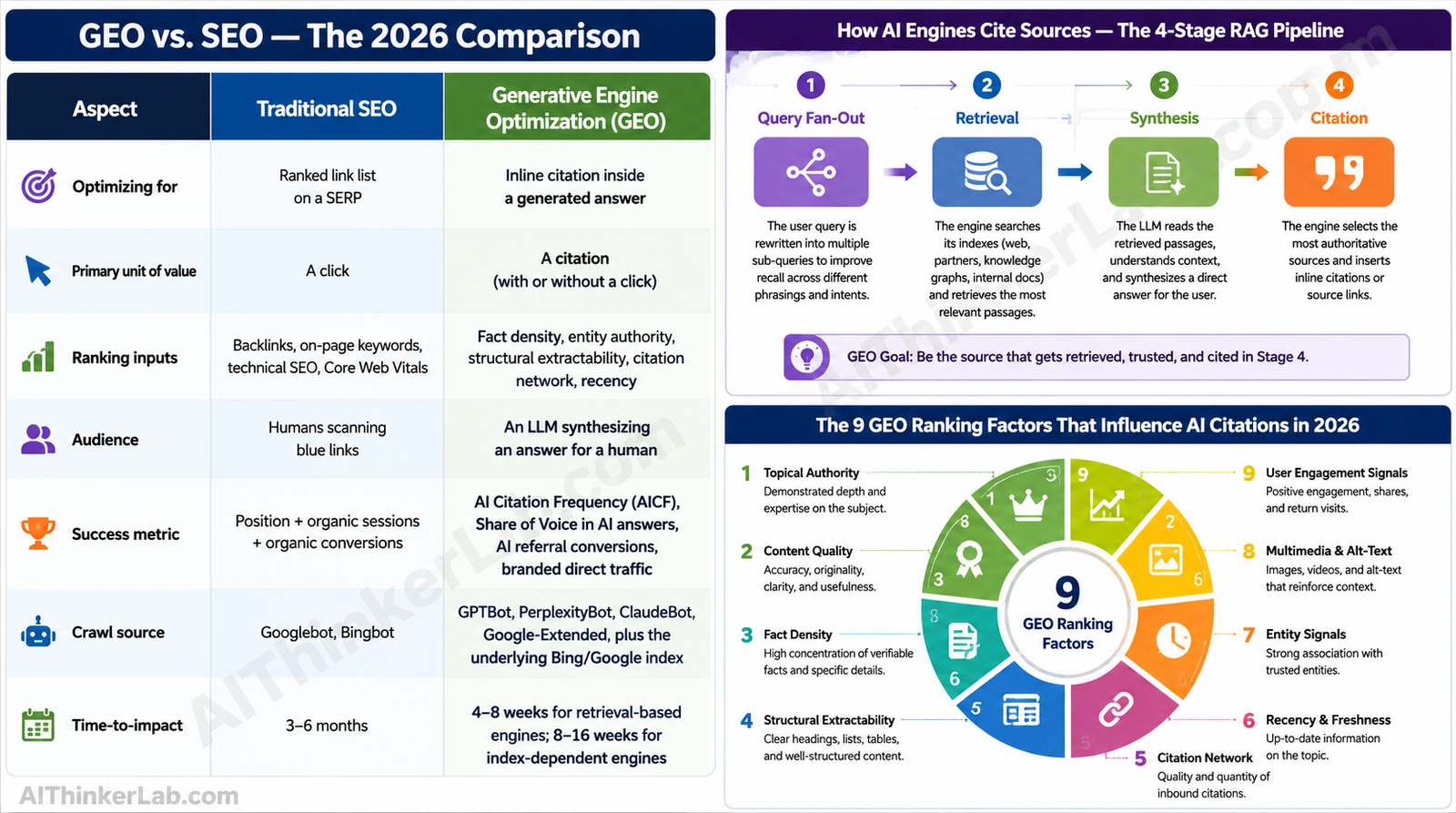
A synthesis of the Princeton/Georgia Tech GEO study (Aggarwal et al.) with 2026 benchmarks finds that long-form comprehensive content is the dominant predictor of AI citation rates. Pages above 20,000 characters receive 4.3x more AI citations. GEO methods from the original Princeton study lift AI visibility by up to 40%. Yet only 40.6% of marketers currently optimize for AI search — despite 92% planning to.
|
|
See the data ->
|
|
|
|
|
|
|
|
Reality Check · 2026 · Jacob Tyler
Out of 62,000+ AI Bot Visits, Only 84 Actually Read the llms.txt File
An honest crawl-data analysis punctures the llms.txt hype: only 0.13% of AI bot visits accessed the llms.txt file across a 62,000+ visit dataset, and the file performed 3x worse than a normal page in direct testing. More striking: 28% of ChatGPT's most-cited pages have zero Google organic visibility. Traditional SEO rank explains very little about why brands get cited.
|
|
Read the analysis ->
|
|
|
|
Content Optimization · 2026 · MarketEngine
Content Scoring 8.5/10+ on Semantic Completeness Is 4.2x More Likely to Be Cited in AI Overviews
MarketEngine's July 2026 guide on semantic completeness and answer block optimization finds that comprehensive topic coverage — not domain authority — is the primary predictor of AI Overview inclusion. Pages scoring 8.5/10+ on semantic completeness are 4.2x more likely to appear in AI citations, while structured answer formats (clear question-answer pairs, definition blocks, numbered processes) show 2.5x higher citation rates than unstructured prose. The query fan-out model AI systems use rewards content that anticipates follow-up questions, not content that answers a single query and stops.
Read the guide ->
|
|
Navarro's Take
"The Tinuiti number that should reset everyone's strategy: AI Overview citations from top-10 organic results dropped from 76% to 38% in 8 months. That means the assumption that 'rank well, get cited' has already stopped being true — not in the future, now. And the Jacob Tyler llms.txt data tells the same story from the other side: the tactics everyone is buzzing about aren't moving the needle the way practitioners assume. What does move the needle is unglamorous — content that covers a topic fully, structured so AI systems can extract specific answers, attributed to verifiable authors. The brands winning AI citations right now aren't doing clever things. They're doing thorough things."
- Ido Navarro, LLMagnet
|
|
|