|

|
|
Issue #76 · July 24, 2026
Adding Statistics to Your Content Lifts AI Citations by 41%. Here Are 60+ More GEO Data Points That Actually Change How You Work.
GEO Statistics 2026 · Omnibound
Omnibound's compilation of 60+ GEO data points is the most complete quantitative snapshot of AI citation behavior available right now, and several findings directly contradict how most marketers are running their GEO programs. The headline stat — adding statistics to content improves AI visibility by 41% (Princeton, KDD 2024) — is widely cited, but the context matters: it's the single highest-leverage on-page tactic identified in controlled testing, outperforming citation-adding, quotation-adding, and fluency improvements.
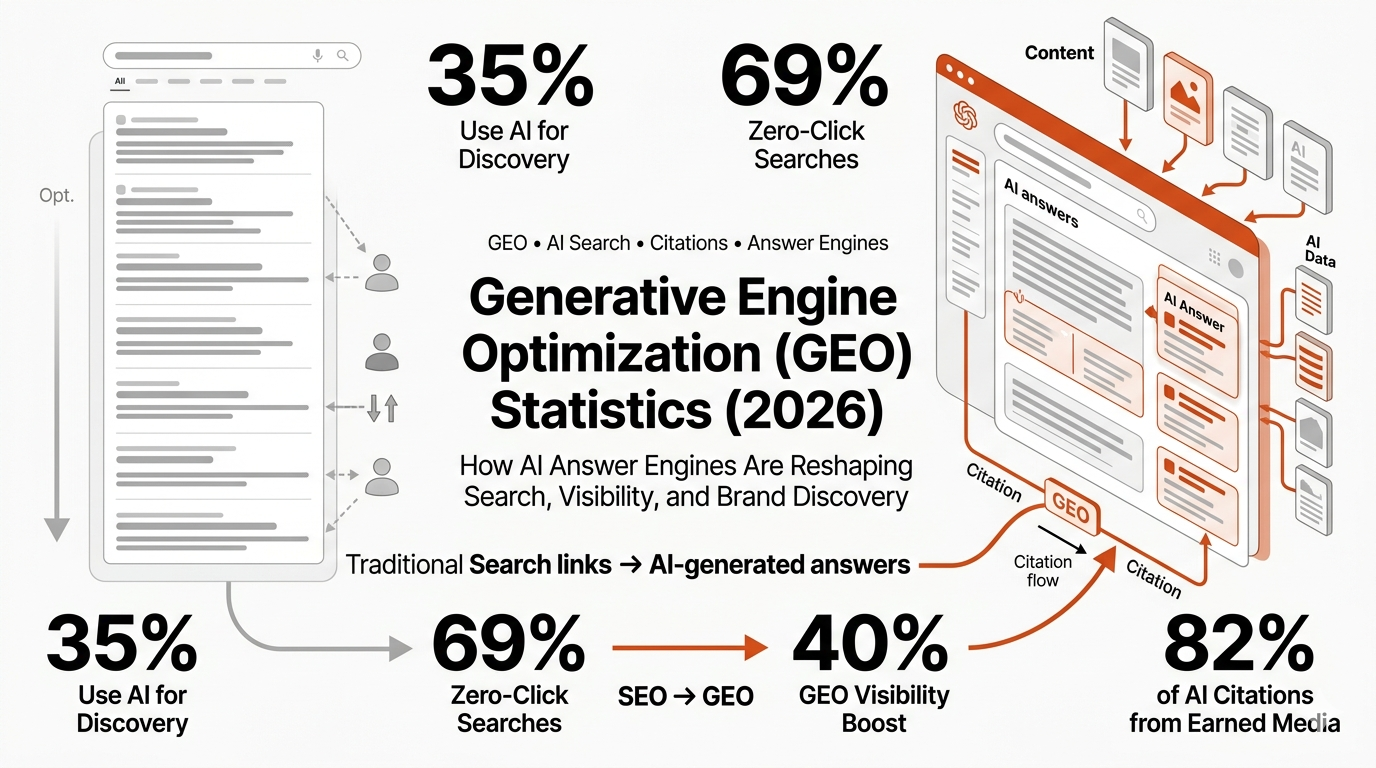
The earned media finding is the one that should reorient most strategies: 82% of AI citations come from earned media — only 6% from paid or owned content (Muck Rack, December 2025). This means your blog and your landing pages are not where most AI citations originate. They come from third-party coverage: industry publications, review sites, forum mentions, news articles. Meanwhile, 35% of US consumers now use AI tools for product discovery versus 13.6% using traditional search — and LLM-referred visitors convert at 15.9% from ChatGPT versus 1.76% for organic search. The gap between AI traffic quality and where most GEO investment goes (owned content) is the underappreciated strategy error of 2026.
|
|
|
|
|
|
B2B Citation Benchmarks · 2026 · Averi
Only 11% of Domains Are Cited by Both ChatGPT and Perplexity. The B2B Platform Gap Is Wider Than Most Teams Realize.
Averi's analysis of 680 million AI citations finds that ChatGPT and Perplexity operate as nearly independent citation ecosystems — only 11% of cited domains appear on both platforms. For B2B SaaS brands, where 73% of buyers now use AI tools in their research process, the platform divergence creates a practical targeting problem. ChatGPT favors pages with 120-180 word sections between headers (70% more citations than longer sections) and Wikipedia-anchored source chains. Perplexity is Reddit-heavy (46.7% of top citations) and freshness-sensitive. The same content, optimized once, underperforms on at least one platform.
|
|
Read the benchmarks ->
|
|
|
|
|
|
|
|
AI Search Roundup · July 10, 2026 · Adapt Worldwide
ChatGPT Commands 92.4% of AI Referral Traffic. Only 36 Brands Rank in the Top 100 Across All Four AI Platforms.
Adapt Worldwide's June-July roundup aggregates the quarter's most significant AI search shifts. ChatGPT's 92.4% standalone AI referral traffic share — measured across 644,000 monthly LLM sessions — masks a structural problem: 28.8% of those referrals land on internal search pages rather than the intended destination, meaning a quarter of ChatGPT traffic is effectively wasted by poor URL structure. The SEMrush AI Visibility Index's finding that only 36 brands maintain top-100 status across all four major AI platforms (ChatGPT, Perplexity, Gemini, Google AI Mode) is the most useful competitive benchmark to emerge from Q2 2026. Claude's 64x growth since late 2024 is the other signal most brands aren't watching.
|
|
Read the roundup ->
|
|
|
|
Ranking Factors · 2026 · Wellows
47% of Google AI Overview Citations Come From Pages Below Position #5 — and Multi-Modal Content Gets 156% More Selections.
Wellows' 2026 AI Overviews ranking factor analysis quantifies what's changed since traditional SEO correlation studies. Domain authority's correlation with AI Overview citations dropped from 0.43 to 0.18, while semantic completeness (r=0.87) and multi-modal content integration (r=0.92) now lead the field. Pages combining text, images, and video earn 156% higher AI Overview selection rates. Schema markup delivers 73% higher selection rates versus equivalent pages without it. The 47% below-position-5 citation rate is the clearest evidence that AI Overviews and organic rankings are not the same competition — and you need to be optimizing for both independently.
Read the ranking factor guide ->
|
|
Navarro's Take
"The earned media finding from Omnibound is the one most GEO programs aren't built around: 82% of citations come from third-party coverage, not your own content. Most brands I talk to are investing in blog posts and landing page optimization and wondering why their citation rates aren't moving. The answer is that the content doing the citing work is living on other people's sites. That shifts the real GEO priority to PR, digital coverage, and review site presence — the same infrastructure that takes 6-12 months to build. The 36-brands-across-all-four-platforms finding confirms it: cross-platform AI visibility isn't an SEO execution problem, it's an authority-building problem. Most businesses don't have a content gap, they have an off-site mention gap."
- Ido Navarro, LLMagnet
|
|
|